MAY 25, 2012
Traveling to Samaria means crossing out of Israeli-controlled territory and entering the land that is under the dominion of the Palestinians. It is odd to be crossing through check points with tall concrete dividing walls within the same nation. But there is a noticeable different in the cleanliness of the land and the deterioration of the buildings once you cross the border. More garbage lines the streets and more buildings have broken out windows. The streets seem quieter because there is less commerce and more people loitering with little to do.
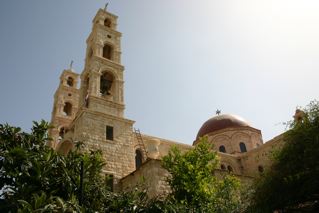
In the region of Samaria, the official site of Jacob’s well is located under a beautiful Byzintine church. Unlike many biblical sites where the exact locations are often ‘theorized” by archeologist and biblical scholars, wells are immoveable and so we were certain that we were indeed visiting the authentic place where Jesus met the Samaritian woman and offered her Living Water. What a thrill to be standing beside that deep pit of fresh water! The church would not let us take pictures, but it is a sight I will always remember.
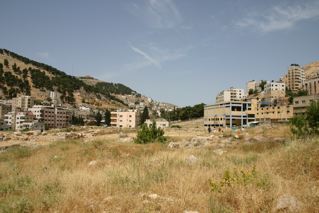
Next we drove through the streets of Naplus where we came to a place known for it’s recitation of blessings and curses in the Old Testament.This was a place that looked much like a dangerous slum back in the US. As we stood in the small valley inbetween Mt. Gerizim and Mt. Ebal we recounted the ancient scene surrounding the giving of the law in Deuteronomy 11 and Joshua 8. The narrowness of the place where these two mountains converge gave me a clearer understanding of how the two shouting parties could have heard each other making their proclaimations many years ago.
From there we drove up to the little mountain-top town of Samaria. So much of the land feels just like it must have felt thousands of years ago. It is hot and dry here. The buildings are very old. The streets are narrow. There are not many indicators of the modern world. In Samaria. everyone tries to make money off the visitors so when they see our bus pulling through the streets they accost us with their wares. 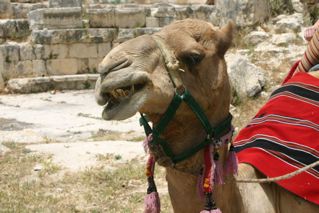 Even a local camel owner saddled up his beast and brought him to our lunch site to solicit camel rides for 10 shekels. Of course, I’m such an animal lover, I was happy for the opporunity to snap a few close up pictures of a camel. I think he was even smiling at me. 🙂
On the top of the hill in Samaria we visited the ruins of the old city. There in the crumbling stones of an ancient church it is believed that John the Baptist is buried in the crypt below. There were candles burning in his memory and offering plates set near a Byzantine era painting. Of course – locals were following us around and trying to sell us the moon. They are always nice to your face until you decline to buy something and then you shouldn’t be surprised if they spit on you in disgust. This happened to me on the site of Sebasti where a local man tried to charge us money to enter a site that was supposed to be free. He was demanding 10 shekels a person to open a gate for us to see a public monument. When we declined to pay him and then eventually refused to enter the site all together – he spit in disgust as he passed by me.
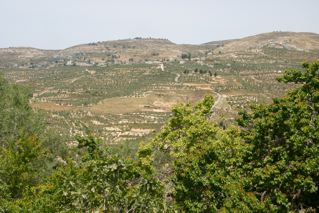
Samaria is a place that many people have not been able to visit in recent years because of the ongoing conflict between the Palestinians and the Israelites over the land. We were grateful for the peaceful relations that allowed us to visit these sites, however it is not a place I am eager to return to. I felt uncomfortable with the instability of the region and the usury of visitors. We are a group of students not tourists, and still I felt manipulated and preyed upon. It was a welcome relief to cross back over the border and feel safe and secure behind the ancient walls of the Old city of Jerusalem.
 Mary Ann Noack
Interestingly we were with a high level Palestinian fellow for our guide. He spoke about the harsh experience of the Palestinians trying to go through the same checkpoints. Also he argued that the Israeli manipulations were a lot more effective and less obvious. For sure the Israeli side is far higher standard of living. Is that because they are better at business or have more powerful friends? It’s a very messy cultural political situation!
Yes Indeed! We had wonderful Palestinian drivers and most of the people we befriended in the city were Palestinians. What a wonderful, gracious and hospitable people! We have been praying daily for “shalom” in this land as we see such potential for peace. This whole experience has been so insightful on so many levels. 🙂