MAY 28, 2012
Today we embarked on a four-day exploration of the land of Galilee. Our first stop was the city of Caesarea, located on the Plain of Sharon on the Mediterranean Sea.
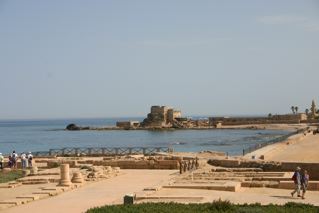
This beautiful seaport setting was one of King Herod’s many lavish building projects (25-13 BC) with an artificially made harbor that could port over 200 ships. This was even larger that the harbor in Athens! Herod the Great, a megalomaniac by any standard, was a man of incredible vision and political savvy. He named the city in honor of the Roman Emperor Caesar (Caesar Augustus), dedicated a temple to Augustus and built a large hippodrome (horse racing track), palace and amphitheater.
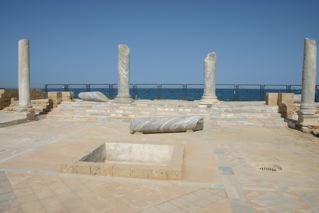
The setting of the city is one of the most beautiful locations I have ever seen. As we sat together in the outdoor theater overlooking the turquoise waters of the sea, we were reminded of the story in Acts 12 when Herod Agrippa was struck dead by an angel in this very place because he refused to give glory to God. This happened when some commercial trade partners from the north sought to worship him as a god instead of the One True God of Israel. It was a stark reminder that the glory for all of our accomplishments belongs to the Lord alone.
Acts 12: 21 On the appointed day Herod, wearing his royal robes, sat on his throne and delivered a public address to the people. 22 They shouted, “This is the voice of a god, not of a man.” 23 Immediately, because Herod did not give praise to God, an angel of the Lord struck him down, and he was eaten by worms and died.
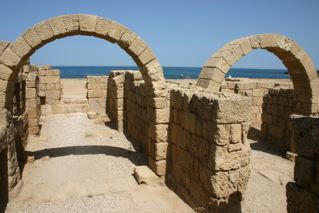 If the walls of Caesarea could talk they would tell stories about the apostle Philip who came to live here with his four daughters who were considered prophetesses. (Acts 8:40). They would reveal the vision that Peter received here about a Gentile man named Cornelius who was ready to hear the gospel and receive salvation (Acts 10). It was also Caesarea where Paul returned at the end of each missionary journey and where he later appealed to Caesar before being imprisoned.
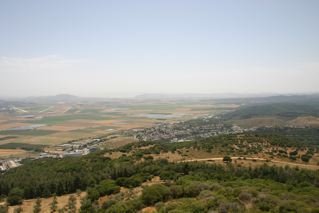
Next, we turned northeast and traveled to an ancient ‘high place” in the Carmel mountain range called Muhraga.
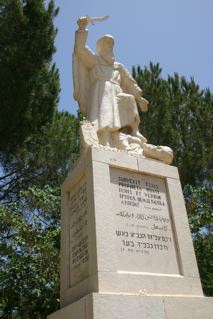
A monastery now rests on this biblical site where the prophet Elijah challenged Ahab to put his Canaanite god to a test. The story in 1 Kings 18 recounts the day when a sacrifice was placed upon the altar and Ahab’s god (the god of fire) was proven powerless in his ability to consume the sacrifice by raining down fire from heaven. Instead, Yahweh proved Himself to be the One True God and all the people proclaimed: “The Lord—he is God! The Lord—he is God!” (1 Kings 18:39)
A little further southeast of Muhraga is the ancient city of Megiddo. Megiddo sits upon a tel (a high hill). It is an ancient city that is located at a very strategic place for conquerors who wished to control the lush and fertile Jezreel valley.
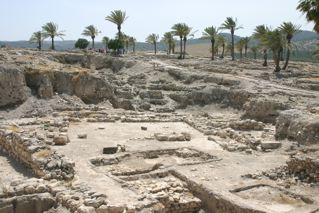
Standing atop the ruins of Megiddo it struck me that under my feet lay 25 layers of civilization that have been conquered by invading enemies. 25 times in Megiddo’s history, the inhabitants were killed, the buildings were destroyed and a new city was established on top of the spoils of war. How many bones were buried beneath my feet? How much bloodshed, hatred, fear and devastation took place here? Was this tel a God created mound of earth, or simply a tall cemetery of conquered communities? The 16th layer of this mound belonged to King David who conquered Megiddo and then dug a tunnel to a spring outside the city in an effort to fortify his people against the next attack. But when the 17th conqueror came – the city was once again dominated by foes who ravished and rebuilt.
Revelation 16 indicates that the battle of Armageddon will be fought at Megiddo. As I stood upon this place that so clearly represented the nations of the earth battling against one another, I thought how profoundly appropriate it would be for the Lord to wage his final battle against the prince of this world in a place that contained the ruins of so many warring civilizations. The more I explore scripture, the more I marvel at the complexity and completeness of each connecting event to the overall story that God is still writing upon the events of human history. How will it all unfold? I am hungry to know more! I look forward to the day when I am able to connect the dots in my own thinking and say “ah ha” when it is all revealed for my finite mind to comprehend.
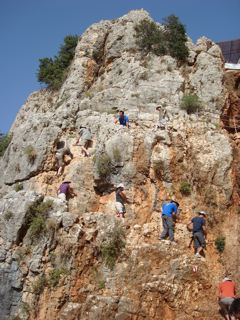
Until then…. a blazing hot and humid late afternoon climb down the cliffs of Mount Arbel just about conquered me. 🙂 The view of the Jezreel Valley from the summit was spectacular and tomorrow we will look forward to exploring the valley floor and the strategic cities that had biblical significance.
 Mary Ann Noack
When we visited the Carmel mountain range and stood at the top near the statue of Elijah, I remember taking in the scenery of the hills surrounding the lush green valley below and the gorgeous blue sky all around us. I pictured the site of a ‘cloud the size of a man’s fist’ coming in the distance eventually bringing the rains that consumed the sacrifices. I’m so thankful we serve a living God who always answers when we call!
Hi Irene, Yes…it’s a spectacular view. And we do serve a living God. I’m so thrilled to know that you share this memory with me. It will certainly enhance our reading of the bible as we can now visualize the settings of these accounts. When were you there?
Love MA
wow!! 87Pearl Harbor: Finding Hope Amidst Devastation